Here’s a lil’ sumthin’ sumthin’ from today’s Age online healthy blog section – not to shabby and not outrageously hysterical (at this stage. Wait until the charred-chops and salty-sausage eaters consider this article a threat to their way of life, all they hold dear and the Great Aussie Dream).
Wednesday, December 22, 2010
Media Watchering, and Bill Clinton, or: something reasonable
Here’s a lil’ sumthin’ sumthin’ from today’s Age online healthy blog section – not to shabby and not outrageously hysterical (at this stage. Wait until the charred-chops and salty-sausage eaters consider this article a threat to their way of life, all they hold dear and the Great Aussie Dream).
Wednesday, October 13, 2010
Argument not over yet, buster, or: babies in the crockpot
Tuesday, October 5, 2010
Forcing it down your throat, or: Don't read the comments.
My experience is the opposite: I have had it demanded of me over the dinner table to explain myself. I recently had a chef tell me I had a mental illness, in a faux-but-not-really joking way. I have had friends introduce me - regularly - as "the vegan". I have had a million questions, all designed to find the tiniest flaw in logic as though the possibility that I would agree that if alone on a desert island having been shipwrecked without communciations devices with a newborn to feed and the absolute certainty that I will never escape then I might drink the milk of the cow stranded with me means that the entire agri-business structure is ethical. I've had countless "I could never ... I love cheese ...." and "Tasty tasty murder", usually while I'm eating. I've had "Well sorry, we're going to order pork anyway", without me having said a word. I've had "plants have feelings hahaha".
Monday, July 5, 2010
Eating Wilbur and Patting Rex, or: re-establising the Farm to Fork Continuum in the public mind
Friday, June 18, 2010
'The Animal Cruelty Syndrome', or: The NY Times follows up
Back in the early 1980s, Lockwood was asked to work on behalf of New Jersey’s Division of Youth and Family Services with a team of investigators looking into the treatment of animals in middle-class American households that had been identified as having issues of child abuse. They interviewed all the members of each family as well as the social workers who were assigned to them. The researchers’ expectation going in was that such families would have relatively few pets given their unstable and volatile environments. They found, however, not only that these families owned far more pets than other households in the same community but also that few of the animals were older than 2.
...“There was a very high turnover of pets in these families,” Lockwood told me. “Pets dying or being discarded or running away. We discovered that in homes where there was domestic violence or physical abuse of children, the incidence of animal cruelty was close to 90 percent. The most common pattern was that the abusive parent had used animal cruelty as a way of controlling the behaviors of others in the home. I’ve spent a lot of time looking at what links things like animal cruelty and child abuse and domestic violence. And one of the things is the need for power and control. Animal abuse is basically a power-and-control crime.”
In a separate study, a quarter of battered women reported that they had delayed leaving abusive relationships for the shelter out of fear for the well-being of the family pet. In response, a number of shelters across the country have developed “safe haven” programs that offer refuges for abused pets as well as people, in order that both can be freed from the cycle of intimidation and violence.
What cannot be so easily monitored or ameliorated, however, is the corrosive effect that witnessing such acts has on children and their development. More than 70 percent of U.S. households with young children have pets. In a study from the 1980s, 7-to-10-year-old children named on average two pets when listing the 10 most important individuals in their lives. When asked to “whom do you turn to when you are feeling sad, angry, happy or wanting to share a secret,” nearly half of 5-year-old children in another study mentioned their pets. One way to think of what animal abuse does to a child might simply be to consider all the positive associations and life lessons that come from a child’s closeness to a pet — right down to eventually receiving their first and perhaps most gentle experiences of death as a natural part of life — and then flipping them so that all those lessons and associations turn negative.
To date, one of the most promising methods for healing those whose empathic pathways have been stunted by things like repeated exposure to animal cruelty is, poetically enough, having such victims work with animals. Kids who tend to be completely unresponsive to human counselors and who generally shun physical and emotional closeness with people often find themselves talking openly to, often crying in front of, a horse — a creature that can often be just as strong-willed and unpredictable as they are and yet in no way judgmental, except, of course, for a natural aversion to loud, aggressive human behaviors.
Monday, June 7, 2010
Things that made me teary this morning, or: Blood sports even for the smallest of creatures
It's not right. It will never be right. Culture and tradition be damned.6 Jun 2010, 2:17AM
Thursday, June 3, 2010
Tasmania could lead the way, or: banning sow stalls
I write to urge you to accept the recommendation of Tasmania's Animal Welfare Advisory Committee (AWAC) that Tasmania ban the use of sow stalls on the basis of unacceptable cruelty.
The United Kingdom and Europe have also recognised that the confinement of pregnant sows in a conrete and metal crate for months at a time without room to turn around constitutes severe cruelty.
It is scientifically well established that pigs are animals with significant levels of intelligence and emotion, much the same as that of a dog. Their technical classification as farm animals is insufficient justification to allow treatment of them that we would not accept if applied to domestic animals and our pets.
The pig industry will attempt to reduce the severity of suffering experienced by sows, and present economic arguments to continue current practices. I strongly urge you to consider instead the moral imperative that each of us bears to uphold acceptable standards of welfare for animals under our care.
I hope very much that Tasmania will lead the nation in banning this unecessary, cruel and inhumane practice.
Yours faithfully,
Sunday, May 30, 2010
Victoria Votes, or: political machinations and the Animal Justice Party of Australia
"Will you empower inspectors to make routine, unannounced visits to Victorian factory farms so that the public does not have to rey on the occasional whistleblower with courage enough to report when animals are kept in cruel conditions that violate the law and the government's own codes of practice?"
"We're not looking at any changes in this area at this point in time, but let me say that animal welfare is a very important issue to our state. How you ensure appropriate welfare for animals is the sign, I think, of any civilised society, and so it is fundamental that businesses that operate in our state should and must operate within the laws that are set in place".
"There will be, from time to time, occasions where the wrong thing is being done but I have great faith in our farming sector, and I think the system is working reasonably well, at present, to identify any inappropriate practices".
Tuesday, May 18, 2010
Testing, testing, or: The Age is discussing animal testing and makeup
Thursday, May 13, 2010
Skinning, or: Just Stop It.
Furry fashion back in style
DAILE PEPPER
May 12, 2010 - 1:40PMA fur vest by Harmony & Lawson. Photo: Luke Thompson
The number of luxury labels across the world using faux and real fur to create their autumn/winter collections is huge and now a Perth fashion label’s real fur creations are flying off the racks.
Chanel sent models wearing full fur body suits down the catwalk, evoking images of woolly mammoths in ancient times, during their recent fall/winter show. Though the luxe label chose to use fake fur rather than the real thing.
Now a Perth label Harmony & Lawson is creating garments made only of real fur, and finding the furry designs are much more popular than ever expected.
Designer Harmony Douglas said her rabbit and raccoon fur creations have proved extremely popular since she launched the label in December.
A creation by Chanel, part of the fall/winter 2011 collection.
“We are just being inundated with sales.”
No longer are Anna Wintour and J.Lo amongst a tiny minority of fashion followers who wear the real thing.
Singer Kelly Rowland purchased a fur vest from the label during her recent visit to Perth, and models including Skye Stracke had purchased the product too. Douglas said she had customers from all over the world.
But the controversy surrounding the use of fur continues. Even those designers that do use fur, refuse to comment on their use of it.
Lisa Ho’s latest winter collection features what has been said to be rabbit fur. But ask her PR team for a comment on her use of the material and you get a quick “Lisa Ho doesn’t comment on fur” response.
But Douglas says very few people voiced concerns to her about the possibility of cruelty, though she realised that for some people fur would always remain taboo.
She sourced her furs overseas, and said government regulations meant the product was farmed like other meat products. All parts of the animals were used. The fur was certified cruelty free.
It was the luxury feel of garments made from fur that was making them popular once again, Douglas said.
“It’s the luxury of it, it's so soft, and my garments are light weight,” she said.
But not everyone in the fashion industry believes the use of real fur can be justified.
While people presume Australian luxe label Aurelio Costarella uses the material to create some of the couture looks they send down the catwalk, the designer has signed the PETA agreement against the use of fur and will never use the real thing.
“We believe you don’t need to use fur as there are so many other great materials and fabrications to utilise," Costarella brand manager Paul O’Connor said.
At the end of the day it’s about using your creativity to make a luxury product and one that is desirable to all.”
Tuesday, May 11, 2010
Lambkin, or: who looks at this and thinks "I'll kill it and eat it"?
- We can't justify leaving newborn, weak lambs out to die because the market is strong. But it's not wrong to abandon defenceless babies to slowly starve to death or be mutilated by crows and foxes.
- Units. Not lambs or sheep but units.
Wednesday, April 21, 2010
Today's Guardian: Why I Must Not Teach My Children What I Think Is Ethical Behaviour But Omnis Can
I find it interesting that when vegan parents write about their own experiences here, the response is "And here are the vegan zealots coming out of the woodwork". The question is about veganism and kids; these people have experience with it and choose to write about it, but suddenly they're proselytising weirdos. Each of them has said their kids are healthy but apparently their direct evidence is suspect because they don't take their kids to the local fried chicken shop.
Monday, April 5, 2010
Haigh's is back in my good books, or: I receive a phone call
So I get this. As a company Haigh's chose to use a particular analytical tool which gave them this answer. It had nothing to do with their legal obligations and everything to do with their corporate risk assessment decisions. In my view these are the actions of a company acting sensibly and responsibly. Apparently testing also showed that the level of trace milk in the dark chocolate varied so wildly that one batch to another would record ingredient-level or trace-level amounts. In Haigh's view it was not safe to label this variation as simply 'may contain'.
Friday, March 19, 2010
An abuser is an abuser, or: the US starts seeing animal abuse for what it is (and isn't)
Although I see that these changes place animal abuse firmly in the real of abuse-response services, which is appropriate, and that it is widely acknowledged that the abuse of animals is a leading indicator of the abuse of humans, I still feel a little sad that the article implies that some of these laws are only here to identify and prosecute animal abusers as a means to identify and prosecute human abusers. It's an important link and one which has been instrumental in raising the profile of animal abuse as something to be acted upon, but we must also recognise that abusing animals is wrong because it is ... abusing animals. An abuser is an abuser.
Tuesday, February 16, 2010
Haigh's responds, or: I just can't explain
Wednesday, January 13, 2010
A little bit about the current state of food law in Victoria, or: I just don't geddit.
- The principal State Act that controls the sale of food in Victoria is the Food Act 1984 (the Act). Quite funnily, the Act is noted on the DHS website as being "the applicable legislation for ensuring the wholesomeness and purity and standards for food sold in Victoria." Oh giggling!
- The Act is also the means through which the Australia New Zealand Food Standards Code is applied as the law in Victoria (the Code).
- The Code's website contains the following statement in relation to 'may contain traces of':
"You’ll notice some labels say ‘may contain’ certain allergens, for example ‘may contain nuts. This is put on by the manufacturer who may be concerned that, while nuts aren’t added to the food, traces may be present due, for example, the product having been made on the same equipment as products containing nuts. Allergy consumer support groups are working with the food industry to make these labels more helpful to allergy sufferers."
- Under Chapter 1 - General Food Standards, Part 1.2- Labelling and Other Information Requirements, the Code has a number of provisions relevant to us. They are: Standards 1.2.3: Mandatory Warning and Advisory Statements and Declarations, and Standard 1.2.4: Labelling of Ingredients. What does each Standard say that is relevant to us?
- Standard 1.2.3: Mandatory Warning and Advisory Statements and Declarations says that certain substances must be declared on labelling where the substance is present in food as an ingredient, an ingredient of a compound ingredient, a food additive or component of a food additive, or as a processing aid or component of a processing aid. (In case you're wondering, wine doesn't declare the use of milk solids or isinglass used as a processing aid as it is not longer present in the food).
- So what is the definition of 'ingredient'? Standard 1.2.4: Labelling of Ingredients provides the definition used in the Code and therefore also in the Act. It is: "ingredient means any substance, including a food additive, used in the preparation, manufacture or handling of a food".
- So at this point a person might, quite cleverly, conclude that this all hangs on the definition of ingredient, and that seeing as milk in the formerly dairy-free dark chocolate at Haigh's is not a food additive, or used in the preparation, manufacture or handling of the chocolate, it is therefore not an ingredient.
- But then! You may encoutner Standard 1.4.2: Maximum Residue Limits. You might open the attachments. And unless you are a biochemist familiar with residues named SUM OF AVERMECTIN B1A, AVERMECTIN B1B AND (Z)-8,9 AVERMECTIN B1A, AND (Z)-8,9 AVERMECTIN B1B and ACIBENZOLAR-S-METHYL AND ALL METABOLITES CONTAINING THE BENZO[1,2,3]THIADIAZOLE-7-CARBOXYL MOIETY HYDROLYSED TO BENZO[1,2,3]THIADIAZOLE-7-CARBOXYLIC ACID,
EXPRESSED AS ACIBENZOLAR-S-METHYL and BOSCALID COMMODITIES OF PLANT ORIGIN: BOSCALID COMMODITIES OF ANIMAL ORIGIN: SUM OF BOSCALID, 2-CHLORO-N-(4’-CHLORO-5-HYDROXYBIPHENYL-2- YL) NICOTINAMIDE AND THE GLUCURONIDE CONJUGATE OF 2-CHLORO-N-(4’-CHLORO-5- HYDROXYBIPHENYL-2-YL) NICOTINAMIDE, EXPRESSED AS BOSCALID EQUIVALENTS .... then you too will have no idea what these residues are, let alone whether they affect your beloved dark peppermint chocolate frogs. (Actually, Cindy?) - But it remains: subject to the caveat that some of those hoxy-poxy-di-deca-coagulate-thingummywhatsits might indicate a certain trace level of milkiness, milk is not an ingredient in the formerly dairy-free dark chocolate at Haigh's. It does not meet the definition. And what's more, there has been no recent change that I can see to Victoria's food safety laws. Indeed, the Act nominates the Code as being of binding force in Victoria, and the Code notes that allergy groups and manufacturers are currently working together to address the trace element issue. It does not say that too much residue is classed as an ingredient. It does not suggest that the way to address the possibility of too much residue in a product is to simply pop it in the ingredients list. It does not suggest that manufacturers urgently need to change their labelling.
And if I'm wrong, which I might be; or if this is a contentious matter, which it is; or if I was just a little bit tired and woozy when I wrote this, which I am; or if this, like almost every legal matter, has more than one way of viewing both problem and solution - then why don't we know about it? Why is it so hard to figure this out? Perhaps a friendly biochemist, food technician or food safety lawyer might wish to swing by here to enlighten us. I'm sure we'd all welcome the opportunity to learn more, and I would certainly welcome the possibilty that I might get my dark peppermint frogs back.
Monday, January 11, 2010
Haigh's chocolates - now with added (non-existent) milk, or: My Friday arvo chocolate fix is over.
"A recent audit revealed that traces of milk residues can still be found on manufacturing equipment despite intensive cleaning"
but
"... there is actually no change to the risk to allergy-sufferers as the recipes and ingredients that go into the making of the bars have not changed. What we are now clearly stating on pack is that we cannot guarantee the absence of milk. It is almost certainly going to be present – albeit at a low level".
I think that G&B are confusing problem and solution here. If the problem is that very low level residue remains, this may need to be indicated on the packet. However, to include milk powder as an ingredient clearly indicates that the milk powder is used in significant quantities to actually produce the chocolate, rater than potentially being present due to cross-contamination.
Use in production is very very different to the presence of allergens remaining on the production line. A statement to the effect of there being a measurable residue in the region of x in the product would be more accurate and would probably allow people allergic to milk to make a more informed choice - and for vegans to happily buy the product. I now won't.
Wednesday, December 30, 2009
Lisa's Vegan Murphy's Law, or: But I ...
But I only eat salad.
There is no protein in my diet.
I am anaemic. So wan.
I cannot lift the spoon to my mouth because I am so weak.
I have wasted muscles.
I only eat organic, biodynamic fruit that has fallen from a tree.
I sneer at Level 5 vegans.
I crave bloody flesh and secretly devour it at any opportunity.
I cannot truly envisage a life without chocolate and cheese.
I am mightily tempted by "but it's a just a little bit of ...".
I cannot cook.
I do not enjoy eating.
I do not understand the Circle of Life (although Simba has promised to explain it to me).
If only I got to raise a lamb as a child and then slaughter it for Sunday dinner I wouldn't be squeamish.
I cannot satisfactorily answer the question "But if we all stopped eating meat then what would happen to all the cows, huh?".
I am swayed by your arguments about our dominance in the food chain.
Because I care about animal rights I automatically do not care about human rights.
I am "just going too far".
I enjoy criticising my hosts and their food.
I love to preach and lecture.
I never encounter obnoxious omnis who bait me and wait for just one response, which qualifies as preaching and lecturing on my behalf.
Tuesday, December 8, 2009
There is no ethical ice cream, or: Knock it off, Nat
I love you. I loved your vegan shoe range fo Te Casan - I bought two pairs in New York. I love that you went vegan after reading Jonathan Foer's book 'Eating Animals' (a copy of whoch sits pristinely on my bookshelf, awaiting my consumption) and I love that you wrote an accessible, sensible and intelligent piece for the Huff Post about how the book turned you into an activist. And you're pretty.
I thought it was great that in this (admittedly fairly insipid) interview by Australian Brad Blanks you directly credited what you learnt about factory farming from Eating Animals with turning you vegan. I like - a lot - that you said you were "horrified", because horrible and horrific it is.
It was also good that when you were asked "So no more ice cream?" you said there was rice cream, and soy ice cream, and having seen the incredible, knock-your-socks-off range available in Whole Foods, I know there is no shortage of vegan frozen desserty things available to you.
So why did you follow it up with this: "But if you can find dairy that's ethically produced, then that's ok and you can have some then".
It's not ok. It's not ok in my opinion at all, but it is especially not ok to say that you're vegan and then make exceptions for "ethical ice cream".
I doubt you would make an exception for "ethical meat'" (happy meat, schmappy meat), so I wonder if you have in fact grasped that it's not only huge factory farming operations that exploit, abuse and discard dairy cows and their offspring. An ethical cow in an ethical field eating ethical food milked with ethical hands producing ethical milk has still been kept in a state of perpetual and enforced pregnancy so that she will lactate; had her male calves taken away and killed as they are useless; her milk which is intended for her babies taken away for your ethical ice cream; and at the end of her milking life - which, like human women, is long before the end of her natural life - she will still be taken away to die. Not so sweet.
And in any case, on a purely pedantic level (because I know you are a bright person who is multilingual and went to university and is not a fool), you can't be vegan-except-for-when. You can be a vegan who makes mistakes. You can be a vegan who is learning. You can be an aspiring vegan. You can be a vegan who accidentally ate dairy and egg-filled cake at Vegie Bar when they got her order wrong and her poorly attuned palate didn't pick it up. But you can't be a vegan with permanent non-vegan exceptions.
Knock it off, Nat.
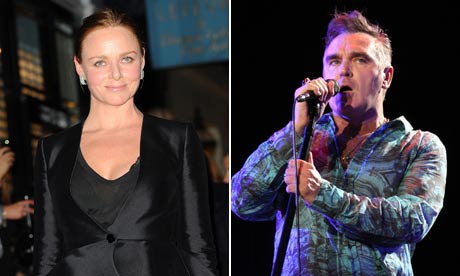
My first-born for a pair of shoes, or: Stella and Morrissey, Shoe Elves
http://www.guardian.co.uk/lifeandstyle/2009/dec/03/stella-mccartney-morrissey-vegan-footwear
McCartney and Morrissey: a match made in heaven?
FASHION DILEMMA
Stella McCartney and Morrissey. Photograph: Ferdaus Shamim/Alex Sudea/WireImage.com/Rex Features What's the best designer collaboration of all time?
We heard something amazing this week. And when we say amazing we're not talking vaguely interesting water-cooler conversation about X Factor Olly's tight, shiny trousers. We're talking earth-shattering, jaw dropping, 'I've found life on Mars'-type news. See if you can guess who it's about from the following quotes (although the picture and the title of this piece MIGHT have given you a clue):
I do maintain that if your hair is wrong, your entire life is wrong. (1984)
As I grew up I used to love stationery and pens and booklets and binders. I can get incredibly erotic about blotting paper. (Star Hits, 1985)
Yes I have had a tan, actually. I went to Los Angeles and got one there, but it didn't make it back to Britain. You're not allowed to come through customs with a tan. (i-D, 1987)
Oh, the wit! It could only be that super vegetarian and songster of high renown, Morrissey (or Mozza to those who adore him and are too lazy to say his full name). And the big news is that APPARENTLY he is teaming up with Stella McCartney to produce a range of vegan footwear.
We're finding the whole thing quite hard to believe. Especially as Stella was also said to be in talks with warbling vegetable - sorry, we mean vegetarian Leona Lewis (who we couldn't give two hoots about), but this turned out to be just a rumour. Now we're praying to all the gods on our radar - currently Zeus, Buddha, Shiva and the Almighty - that the same is not true of the McCartney-Mozza collaboration.
According to the blogosphere (I think that's the first time we've used that word in Fashion Statement), the footwear will be leather-free (nothing that died with a face, we assume) and they hope to launch it next year. Stella's known for refusing to use leather in her collections, but Mozza has not had quite such a clean track record, as we were helpfully informed by Grazia:
"Despite being a staunch supporter of animal rights, the singer was often spotted wearing leather and suede footwear, and once said of his favourite shoes, (a pair of suede moccasins that were a gift from Pete Burns) 'I find shoes difficult to be ethical about - one just can't seem to avoid leather. One is trapped, ultimately.'"
Trapped, like a wild bear, caught in the barbarous toothed grip of an iron clamp, perhaps. Unable to break free from the allure of a soft, foot-cushioning animal skin … the poor man.
Despite his shady past, Mozza was honoured at Peta's 25th anniversary celebrations in 2005, where he was awarded the Linda McCartney memorial award for acts of kindness towards animals (one of which including calling for a boycott of the entire country of Thailand because of its mistreated elephants).
Anyway, we're expecting great things from the man who came 45th in GQ magazine's best-dressed chart, and the woman who single-handedly brought us the boyfriend blazer.
We'll leave you with a verse from Mozza that we're sure Stella will appreciate as she slices into her nut roast Yule log this Christmas.
And the calf that you carve with a smile
Is murder
And the turkey you festively slice
Is murder
Do you know how animals die?
(From Meat is Murder)

What a lovely country. Let's all go there and pay our respects their ancient and noble traditions, shall we?